
Scientists discover Mary Rose crew’s armour was more ‘modern’ than previously thought
UNIVERSITY scientists have made an exciting discovery about the chainmail armour worn by the crew of the Mary Rose.
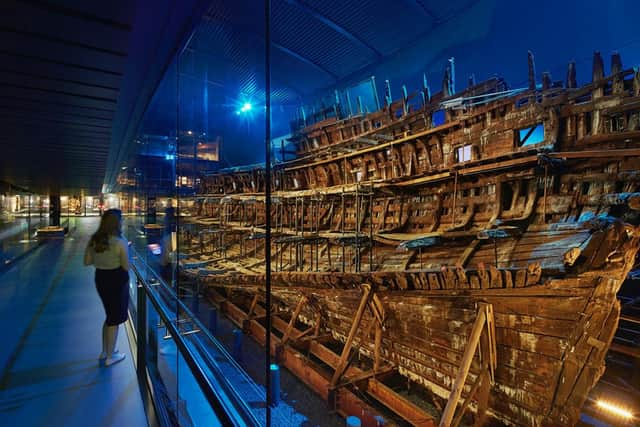
Henry VIII's flagship is synonymous with Portsmouth having sank in the Solent in 1545 before being recovered from the seabed more than 400 years later. The historic ship and the thousands of artefacts on board are now open to the public at the Mary Rose Museum – one of the city’s top visitor attractions.

The chainmail which was recovered has now been analysed by scientists from the University of Warwick. The chain links were examined to reveal a ‘much more modern alloy composition’ than previously thought. An alloy is a combination of metals to improve strength and durability.

A state-of-the-art X-ray facility was used to study the three brass links which were found to be a combination of 73 per cent copper and 27 per cent zinc.
Professor Mark Dowsett commented: ‘The results indicate that in Tudor times, brass production was fairly well controlled and techniques such as wire drawing were well developed.
‘I was surprised at the consistent zinc content between the wire links and the flat ones. It's quite a modern alloy composition.’
The study has also revealed traces of other metals including lead and gold, ‘hinting at a further history to the armour yet to be uncovered’.
However, professor Dowsett believes the presence of these metals may not have been part of the original design.
‘The heavy metal traces are interesting because they don't seem to be part of the alloy but embedded in the surface. One possibility is that they were simply picked up during the production process from tools used to work lead and gold.
‘In a Tudor battle, there might also be quite a lot of lead dust produced by the firing of munitions. Lead balls were used in scatter guns and pistols, although stone was used in cannon at that time.’
The Mary Rose served the king for 34 years and was believed to be Henry’s ‘favourite warship’.