
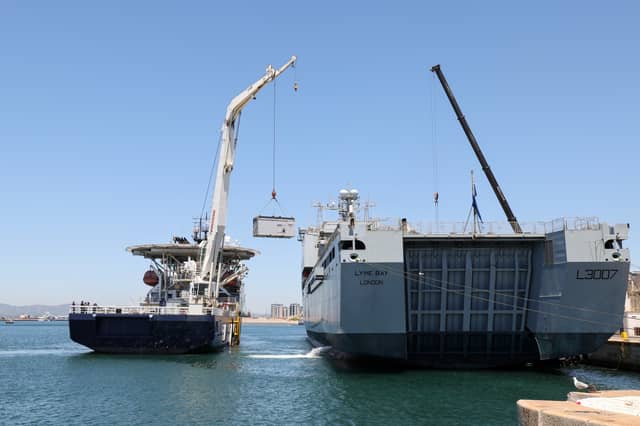


Sophisticated technology and drone boats have been loaded onto a Royal Fleet Auxiliary ship ahead of her being transformed into a mine-hunting mothership.
Un-crewed boats, underwater sensors and autonomous sonar equipment were loaded onto RFA Lyme Bay off the coast of Gibraltar. HMS Stirling Castle brought many of these capabilities from Portsmouth and used cranes to put them onto the auxiliary dock landing ship.
Once loaded, RFA Lyme Bay sailed from Gibraltar with more than 100 expert mine-hunting personnel from the Royal Navy’s Diving and Threat Exploitation Group (DTXG) and Mine and Threat Exploitation Group (MTXG) on board to operate the array of vessels. It was announced earlier this year that the ship would be brought to heightened readiness and will act as the main platform for autonomous equipment, with the Royal Navy stepping up its mine-hunting capabilities.
The force said all of the technology loaded onto the ship has undergone thorough testing and trials, with some already being used on various exercises around the world to prove its ability to operate in various environments. Commander Dan Herridge, Commanding Officer of MTXG, said: “Personnel from MTXG will embark in RFA Lyme Bay with a clear purpose: to deliver a credible, modern Mine Countermeasures capability.
“Enabled by the Mine-hunting Capability Programme, they will employ cutting-edge sensors delivered through autonomy and AI to detect threats to the maritime community in some of the world’s most challenging environments. Working closely with specialists from DTXG, these threats will be neutralised. This deployment reflects a significant, collective effort from across the enterprise bringing together people, platforms and technology at short notice to field an effect modern capability and ensure the Royal Navy remains ready to counter evolving maritime threats.”
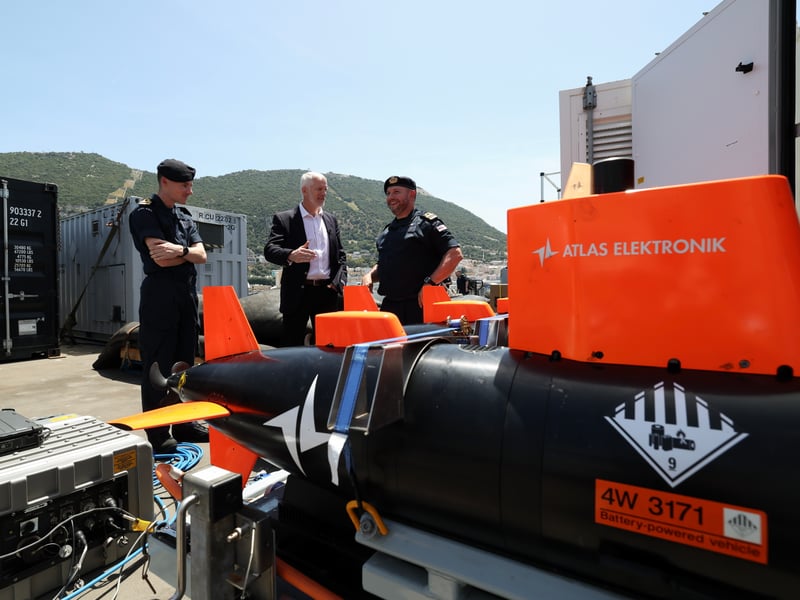
RNMB Ariadne, a 12-metre Royal Navy Motor Boat, is among the capabilities being used. The vessel is designed to detect and destroy sea mines without the need for personnel to enter deadly minefields. Other equipment on board will be a multi-role crewless boat which can deploy Seacat – an autonomous underwater vehicle that can produce a detailed 2D or 3D sonar picture of the seabed and un-crewed underwater vehicle (UUV) Remus which can survey the seabed.
Personnel worked around the clock to get the equipment to Gibraltar, from trialling new technologies to strengthening them and adapting them for possible new operations. Many of the crew aboard RFA Lyme Bay have already operated in the Middle East on traditional mine-hunting ships. Their background knowledge and experience will prove crucial to operating in the Gulf.
The UK and other countries such as France will be part of a multinational effort to keep the Strait of Hormuz open. The strategic waterway, where 20 per cent of the world’s crude oil and liquified natural gas flows through, has been in Iran’s stranglehold since the war broke out against the US-Israeli coalition. Portsmouth-based Type 45 destroyer, HMS Dragon, has already been pre-positioned in the Middle East.
The US Military announced that strikes were carried out in southern Iran on May 25, targeting missile launch sites and boats placing mines. They described them as “defensive” and said the US acted with “restraint” in light of the weeks-long ceasefire.
Iran’s foreign ministry called the strikes a ceasefire violation and warned that Washington would bear responsibility for “all consequences”, without details. “The Islamic Republic of Iran will leave no act of aggression unanswered,” it added in a statement. The strikes are the latest flare-up in a fragile ceasefire that began on April 7. The Strait of Hormuz’s closure has resulted in the price of fuel and other commodities to skyrocket, with its reopening being central to the talks alongside the long-running issue of Iran’s nuclear programme and highly-enriched uranium.
Discussing RFA Lyme Bay’s deployment, Rear Admiral Philip Game, Director Operations for NAD Plans and Portfolio, said: “We are working alongside British industry to deliver advanced autonomous capabilities directly to the front line. This mission is not just a temporary crisis response; it reflects our role as a trusted advisor and strategic partner, deploying UK tech to protect global commerce and reinforce our long-standing security commitments in the Gulf."
RFA Lyme Bay has also gone through a cyber check to ensure she and those aboard are protected from digital spies and hackers. Experts from Royal Navy Digital’s Maritime C5i Support Unit (MCSU) conducted an assessment of the support ship’s IT and personal electronic devices – mobile phones, tablets, smart watches and the like – while she was in Gibraltar. The team identified both areas for improvement and areas of strong performance, including effective anti-virus management, strong education and training delivery, and good adherence to the portable electronic device policy.
9. Mine-hunting kit bound for Strait of Hormuz
Minister of Armed Forces Alistair Carns DSO OBE MC MP getting a brief from a member of the embarked squadrons on RFA Lyme Bay. | UK MOD Crown copyright
10. Mine-hunting kit bound for Strait of Hormuz
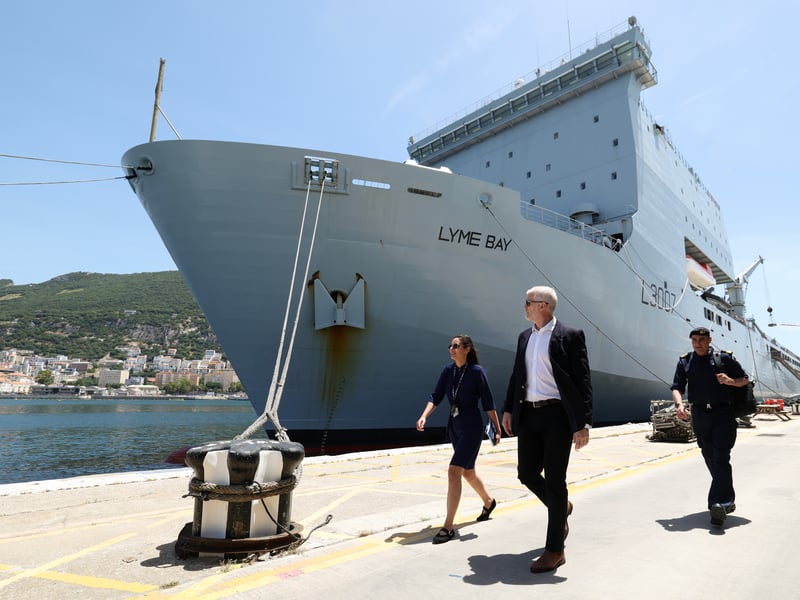
Minister of Armed Forces Alistair Carns DSO OBE MC MP leaves RFA Lyme Bay to visit HMS Stirling Castle. | UK MOD Crown copyright
11. Mine-hunting kit bound for Strait of Hormuz
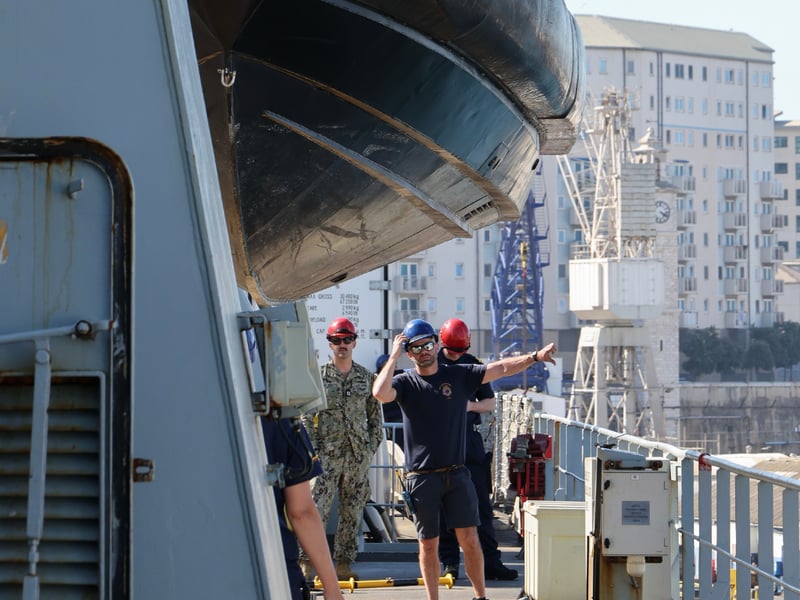
The Royal Navy will be part of a prepared multi-national effort alongside France and other Nato allies to keep the Strait of Hormuz open. They are expected to deploy when conditions allow, and when hostilities cease between the US-Israeli coalition and Iran. | MoD Crown Copyright