
‘So proud I could cry’: HMS Prince of Wales returns home to Portsmouth after contending with Russian aircraft

The deployment was described “incredibly busy” and one which the ship’s company will remember
Smiling families and colourful banners greeted the Royal Navy flagship as she returned home from a vital Nato deployment.
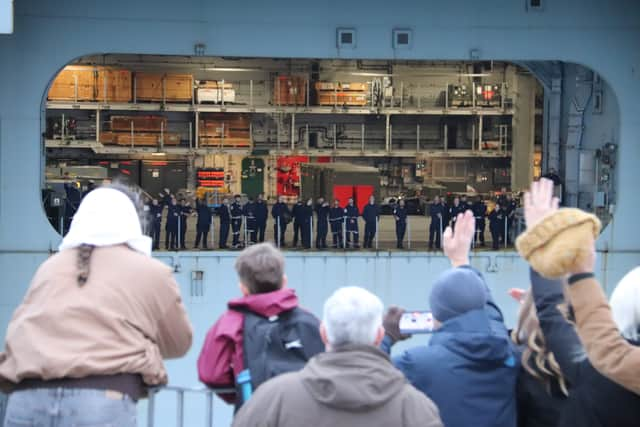
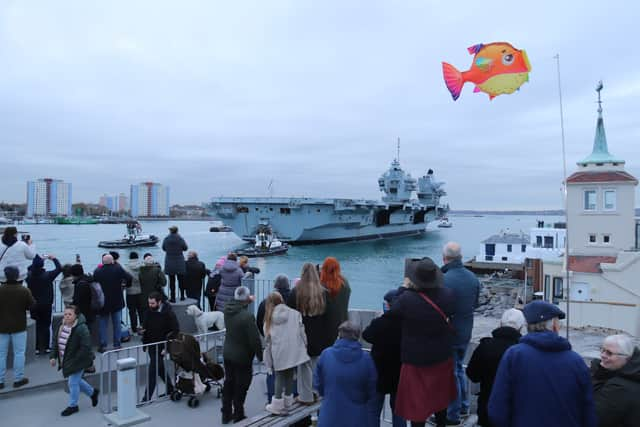
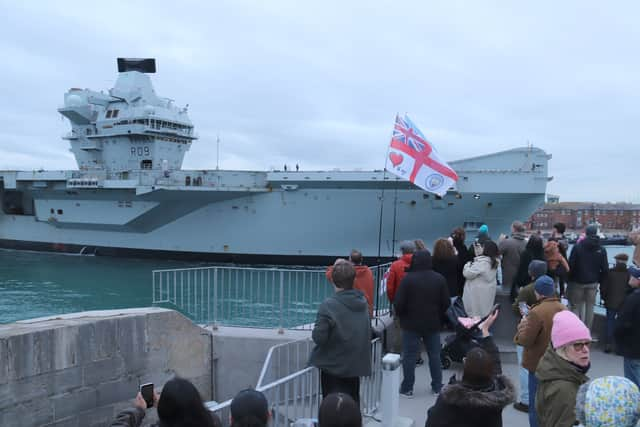
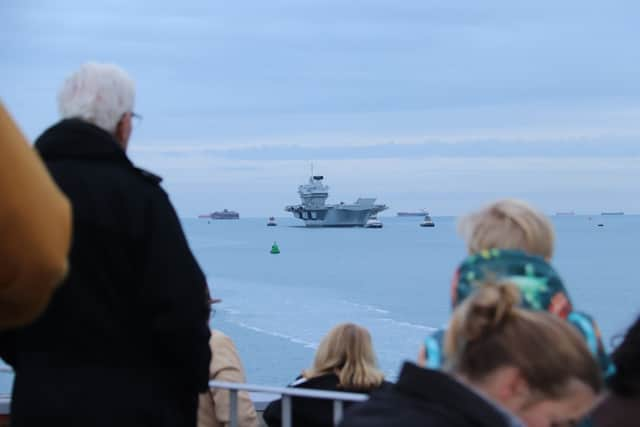
Crowds gathered to welcome back HMS Prince of Wales as she sailed to HMNB Portsmouth at around 3.53pm this afternoon (November 16). The horn sounded as families frantically waved to their loved ones while standing on The Round Tower and along the Hot Walls.
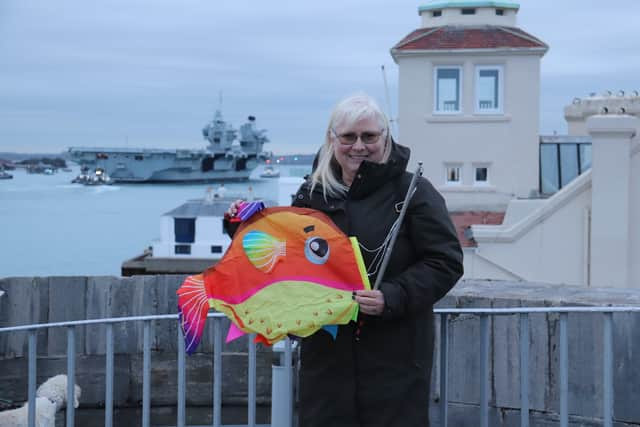
After an intense series of operations where personnel had to contend with bitterly cold temperatures and Russian aircraft, they were parents were happy to be reunited with their loved ones. Sarah Batter, of Fareham, is extremely proud of her son AB Kieran ‘Dave’ Batter. She was waving a brightly coloured fish banner to catch his attention.

“I’m so proud I could cry”
She told The News: “He’s been with the ship for three and a half years and has seen the world. Every time he comes home, it’s really exciting to see him.
“He has been so lucky, been to so many places and so many opportunities he wouldn’t have got otherwise. He’ll definitely be able to see the banner, it’s worked in the past. It’s tradition now that every time he goes and comes back, I’ve got to get the fish banner out. It’s very visible from the ship.”
When asked how he contended with the freezing temperatures and Russian aircraft, she added: “I think they all take it in their stride. It’s part of the job and what they’re trained to do. It’s just another day in the office for them.”
Angela Tillison, of Southsea, waved at her son Benjamin, who has served in the Royal Navy for eight years as an engineer. She said: “Just the thought of it brings tears to my eyes. I can’t wait to see my boy.
“I love the crowds here. We’re a family and we’re all here waiting for loved ones or friends to come home. Seeing people coming out to greet them is a wonderful feeling. Ben loves going away and seeing other countries. He works very hard and it’s so good to have him home. He’s found it tough the past few months with the situations they’re in.
“He’s coped ok and been fixing things. I’m so proud I could cry.”
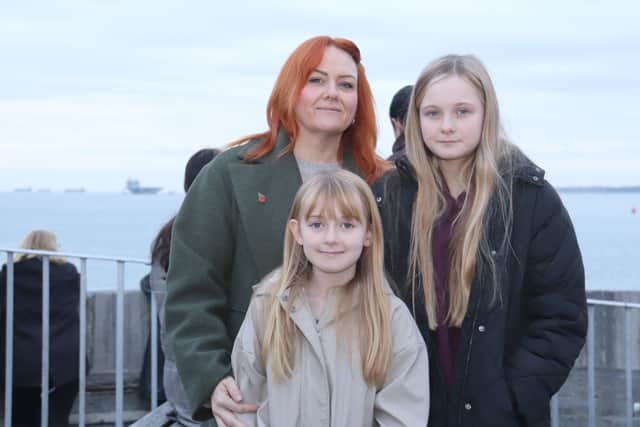
Laura Davis travelled from Cardiff to be reunited with her son AB Sonny Callan, as he returned from his first deployment. “He’s wanted to do it since he was a little boy,” she said. “He’s finally got there, so he’s really happy.
“He’s always kept up with it, but I think since he’s had a surprise since being out there, since being cold. I think he’s going to push forward and go quite far. He’ll deal with everything really well, he’s a strong kid.”
”Incredibly busy” deployment split into two phases
Taking charge of the UK Carrier Strike Group (UKCSG), HMS Prince of Wales completed Operation Firecrest. Conducting complex training drills alongside Nato and Joint Expeditionary Force (JEF) allies, the carrier primarily completed exercises in the North Atlantic and High North. The area is considered to be of high strategic importance, with Russia increasing its presence in the region with more vessels and submarines.
HMS Prince of Wales started the first phase after leaving Portsmouth on April 24, with destroyer HMS Duncan deployed alongside her. Anti-submarine warfare drills were completed throughout May under Exercise Dynamic Mongoose and other smaller drills. Its aim was to replicate the ‘cat and mouse’ situations that may arise while deployed in the region.
A Russian Tupolev Tu-142 'Bear' reconnaissance plane repeatedly flew close to the 65,000 tonne carrier in July while she was operating in the Norwegian Sea. F-35B fighter jets intercepted the aircraft, with a Ministry of Defence spokesperson stating the Kremlin asset acted in an “unsafe and unprofessional” manner.
A large number of sonobuoys was dropped close to the carrier. They’re used to detect, locate and track submarines and other vessels. Exercise Neptune Strike followed, with HMS Somerset and RFA Tidespring joining the carrier in July.
It was the first time the exercise was placed under Nato’s Arctic Sentry. Ships, submarines and aircraft were drawn from 14 countries including Croatia, Denmark, France, Greece, Iceland, Italy, Norway, and the US to name a few. Then-defence secretary Dan Jarvis spoke to HMS Prince of Wales’ ship’s company and met Iceland’s foreign minister Thorgerdur Katrin Gunnarsdottir.
Captain Ben Power, Commanding Officer of HMS Prince of Wales, said: “It has been an incredibly busy period for HMS Prince of Wales and my ship’s company; they have relished the opportunity to deliver during Operation Firecrest as the Flagship to the United Kingdom’s Carrier Strike Group.
“The importance of our business in the High North and North Atlantic has been illustrated at the recent International Sea Power Conference and Atlantic Future Forum, held on board, alongside in Oslo.
“My ship’s company delivered this most significant afloat Defence diplomacy event of recent times, having previously returned from NATO Operations and exercises deterring Russian aggression in the North Atlantic. I am deeply proud of their professionalism, passion and determination to defend their nation. I am also hugely grateful to our families for all their support too.”
The carrier returned on July 24 with families gathering in their droves to see her. She left the naval base on October 18 for the second phase, and was joined by HMS Dauntless under the UKCSG.
A Russian Tu-195 Bear long-range bomber again flew close to the UKCSG during training drills in late October and early November. F-35B fighter jets once again had to be deployed as a countermeasure.
Training drills saw the aircraft dropping live Paveway IV bombs, and conducted exercises alongside Norwegian and American aircraft. Alongside their Scandinavian counterparts, British F-35s escorted a US B-52 in a very rare exercise.
HMS Prince of Wales took on ammunition at the military jetty in Hammernesodden, near Namsos, about 70 miles north of Trondheim, the first time Norway has undertaken such a task. Her air group of F-35 fighter jets and Merlin helicopters.
The fourth iteration of Exercise Neptune Strike involved 17 nations who committed 20 warships and 40 aircraft, including three naval task groups. The carrier was escorted by Norwegian frigate KNM Fridtjof Nansen, HMS Dauntless, HMS St Albans, a French frigate and Norwegian tanker HNoMS Maud.
Diplomatic events then took centre stage when HMS Prince of Wales sailed to Oslo. The warship hosted the International Seapower Conference and Atlantic Future Forum. Top brass and political figures joined together to discuss the growing threats the world is facing, and what the North Atlantic and High North will look like in the future.
Commodore Richard Hewitt, Commander of the UK Carrier Strike Group, said: “Operation Firecrest has demonstrated the strength of NATO integration and the value of a persistent maritime presence in the North Atlantic and High North. Throughout Phase 2, HMS Prince of Wales, HMS Dauntless, HMS St Albans, and our NATO partners have operated seamlessly together, deterring potential adversaries, defending the Alliance's northern flank, and enhancing our collective warfighting readiness.
“From conducting complex air operations alongside Norwegian and US forces to hosting strategic engagements with military and political leaders in Oslo, this deployment has showcased the Carrier Strike Group's ability to generate credible military effect while delivering strategic influence wherever required. It has reaffirmed the United Kingdom's commitment to NATO, strengthened interoperability with key allies, and demonstrated the agility, reach, and relevance of Carrier Strike in today's security environment.
“I am immensely proud of our people. Their professionalism, dedication, and unwavering commitment have been at the heart of every success, ensuring that the Carrier Strike Group continues to deliver wherever the mission demands.”
On the same day as her arrival, HMS Queen Elizabeth left HMNB Portsmouth to resume her busy calendar of training drills. She’ll be expected to take on the role of flagship from next year.