
Forgotten hero Portsmouth pilot’s record-breaking 1930s flight celebrated in new book
HE’S a forgotten hero of British aviation, who flew higher into the stratosphere than any other pilot before him, using an experimental aircraft and one of the world’s first pressure suits.
Now, the record-breaking flight made by Portsmouth airman Ronald Swain almost 90 years ago has been recalled in a new book about high-altitude aircraft of World War II and their operational service, Combat in the Stratosphere.
Born in Southsea in 1903, Francis Ronald Swain was raised in Portsmouth and joined the Royal Air Force in 1922, serving initially with No 2 Squadron, where he flew Bristol F2b fighters.
In 1935, by then a Squadron Leader, Swain was seconded to the Royal Aircraft Establishment in Farnborough as a test pilot, specialising in very high altitude flight. The following year, the RAE decided to make an attempt on the world altitude record, which had been set on 11 April 1934 by the Italian Renato Donati, who reached a height of 47,352 feet in his Caproni biplane.


Their star pilot Ronald Swain was selected for the attempt. He would be flying the Bristol Type 138A, an experimental test aircraft constructed mostly of wood and fitted with extended wings, which had been designed specifically for high-altitude flight. He was also provided with an early pressure suit, allowing him to breathe in the very thin air above 40,000 feet.
At 7.30 am on Monday 28 September 1936, Sqn Ldr Swain – wrapped up in the cumbersome and uncomfortable pressure suit – took off in the Type 138A from the airfield at Farnborough and gradually gained altitude. He described the flight in a newspaper interview shortly afterwards: ‘I climbed in a series of wide circles and, looking down from about 46,000 feet, I saw London like a little toy town, the Thames and other rivers like narrow ribbons, and the Channel Isles like small stones in a shallow riverbed. At that moment I felt very small and lonely.’
Eventually, he climbed to 49,944 feet, beating Donati’s record by over 2.500 feet. The flight back to the airfield did not go smoothly, however. While descending, the visor of his helmet and the cockpit windows became obscured with haze, effectively blinding Swain. ‘This worried me,’ he revealed in the post-flight interview, ‘because I was unable to read the compass. I continued to descend rather erratically, and then I began to feel that I was suffocating and weakening.’
Once he’d reached a lower altitude, where the air was breathable, Swain used his knife to cut away his helmet’s visor and managed to make a safe landing, after a flight lasting around three hours.
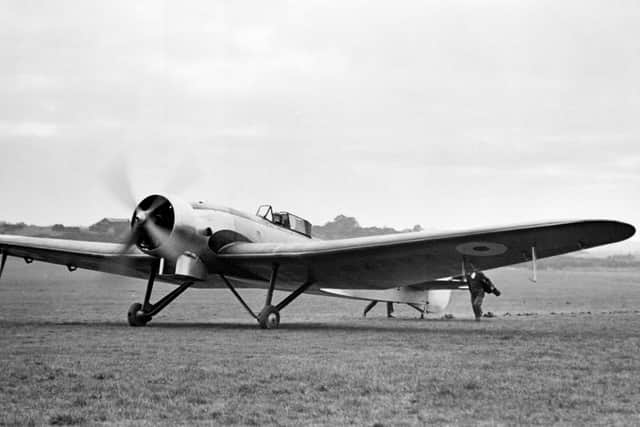
For his extraordinary feat, Swain was awarded the Air Force Cross. ‘Squadron leader Swain has carried out a number of experimental flights at very high altitudes, terminating in the recent successful attack on the World’s Altitude Record. These flights have called for skill, determination and courage,’ stated his medal citation.
Swain remained in the RAF, serving in various staff appointments during World War II and retiring in 1954, by which time he was an Air Commodore. He emigrated to the US and died in Florida in 1989, aged 86.
● Combat in the Stratosphere is now available to buy in hardback (Air World books, £20) Visit: www.steventayloronline.co.uk