
'Even Portsmouth kids spat at me after joining from Southampton': Scott Hiley on the toxic south-coast rivalry - and how he won over Fratton faithful

The defender initially suffered a torrid time after leaving Southampton for Portsmouth - then turned it around
The poem still takes pride of place hanging on the wall of Scott Hiley’s Manchester home.
Chronicling victory over Barnsley on a dramatic final day of Pompey’s 2000-01 season, it is dedicated by author Bob Whittle to ‘The Rock. Truly our Player of the Year’.
It serves as an indelible reminder of a remarkable Fratton Park journey - and the toxic south-coast rivalry.
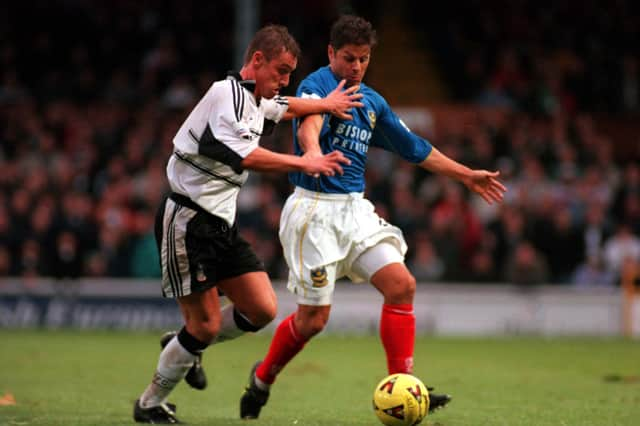

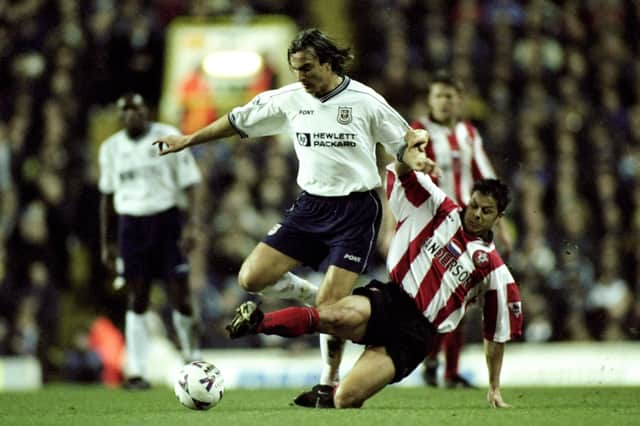
In December 1999, Hiley became the 10th player in Southampton history to cross the divide and join their bitter rivals in blue.
Nonetheless, it wasn’t a defection embraced by all of the Fratton faithful, with many unable to overlook the defender’s previous association, irrespective of his new loyalties and having driven the move himself.
According to Hiley, the traditional honeymoon period consisted being spat at by his own fans, including children, and booed and jeered during home matches, prompting him to instruct his young family to no longer watch their dad.
What’s more, the former Manchester City man was subsequently ostracised and transfer-listed by new manager Tony Pulis, who condemned him to a demoralising bomb squad existence.
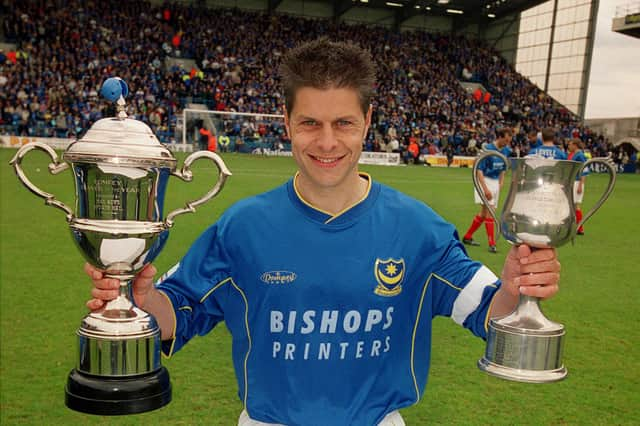
Within 12 months, however, the outcast had established himself as a first-team regular, captain under two managers, the recipient of The News’ Player of the Season, the inspiration for a supporter-run website created in his honour, and the subject of a personalised poem.
Quite the transformation for the one-time Pompey pariah.
‘Every time the ball went near me, my own fans booed’
‘I kind of knew about the rivalry, but never appreciated how bad it would get,’ Hiley told The News.
‘I’d just joined Pompey, yet 14,000 home fans would boo every occasion I touched the ball. Michael Panopoulos was also having a bad time because his form wasn’t great - whereas I was being targeted purely because of the club I had previously represented.
‘Every time the ball went near me, they booed. Should I do something wrong, they cheered. It was as if I was wearing a Southampton shirt while playing for Pompey, it was really bad.
‘On one occasion, I was playing for the reserves at Fratton Park and a fan called me over. He had five kids with him who wanted my autograph, so naturally I found my way to them.
‘As I bent down to collect the pen and paper, he shouted “Go” and all five kids spat at me. They were laughing. I told the guy it was totally uncalled for - but he wasn’t bothered.
‘Another time, in July 2000, we travelled to Aldershot for a pre-season friendly and I appeared as a substitute in the second half. For some weird reason, Tony Pulis put me on the left wing and, on one occasion, as I ran past Shaun Derry, everybody was booing.
‘He asked: “When did you play for Aldershot?”. I had to point out they weren’t actually Aldershot fans, they were Pompey supporters. So he started laughing.
‘Until Pompey, I had never been booed before. I might have taken stick while walking off the pitch after a game, that’s frustration, it’s standard, especially away from home. That sort of reaction is part and parcel, you’ve just got to take it on the chin.
‘But getting booed based on nothing other than where you had come from is mentally hard. You’re up against it from the first minute, tens of thousands of eyes fixed upon you, waiting to criticise, desperate to criticise.
‘Within a few games, I decided I had to leave my family at home on match-days. My daughter was around six and my son about three, but I needed to concentrate on myself, to focus on performing on the pitch.
‘I didn’t want to worry about the awful stuff they’d be witnessing. It was a selfish thing, but I didn't want them to hear 14,000 people booing their dad at that particular time.
‘Thankfully, nobody realised that I had continued to live in Chandler’s Ford when I joined Pompey, I never moved. Besides, it wasn’t far from the Wellington Sports Ground in Eastleigh, where we trained.
‘The only problem was those journeys home after a match, time spent in the car on my own, thinking over and over and over again: “What have I done coming here?”.
An Alan Ball dinner date which led to signing for Portsmouth
It was over dinner at Alan Ball’s Warsash home with Matt Le Tissier and their respective wives when the possibility of Hiley joining Pompey was first broached.
Out-of-favour under Dave Jones and with the prodigiously talented Wayne Bridge driving his way through the youth set-up, the 31-year-old realised his time at The Dell was approaching the end.
As either a right-back or left-back, he had totalled 33 appearances in the 16 months since recruited from Manchester City in August 1998 - yet now questioned whether former boss Ball would be willing to offer him a career lifeline.
Ball, who previously managed the defender at Exeter and Manchester City, was at the time overseeing Pompey, with new owner Milan Mandaric demonstrating a willingness to bankroll success.
A £200,000 transfer was agreed, with Hiley signing a two-year deal in December 1999, yet a powder-keg situation subsequently ignited when Ball was sacked seven days into the defender’s Fratton Park career.
With the Fratton faithful already uneasy about his presence, new boss Pulis never backed the ex-Exeter man and let him sink, handing just six outings during his opening nine months in charge.
Yet that was to significantly change in October 2000 with Steve Claridge’s appointment as player-manager.
‘Steve Claridge transformed my Portsmouth career’
Hiley added: ‘When Pulis left, I didn’t care who was coming in, just give me an opportunity. As it was, it was Steve Claridge - my Pompey team-mate.
‘I had previously played with Steve at Birmingham under Barry Fry, he knew what I could bring to the team. He pulled me in the dressing room and told me I’d be back in the first-team.

‘He said: “I’m going to put a few lines in The News, just to get the message over that I’m backing you. I’ve got a good relationship with the fans so hopefully they will give you a chance”. My response was just play me, I can deal with the booing. Play me and I’ll do the rest.
‘Steve’s first game in charge was against Sheffield Wednesday at Fratton Park - and I was named at right-back for my first league appearance of the season.
‘Supporters were now seeing what I could offer the team on a regular basis. I became captain, I was presented with a new two-year contract, which had been negotiated with Steve while I was getting changed after a training session. He had transformed my Pompey career.
‘We headed into the last game of the season against Barnsley in danger of being relegated. Before kick-off, I was presented with The News/Sports Mail Player of the Season, which ranks as one of my biggest achievements in football.
‘I’d won the Fourth Division title with Exeter, but this had been an incredible personal journey. My situation at Pompey had been dire at the beginning, horrendous even, and I am very grateful the fans took the time to let me show them what I could do. To be able to turn that around so quickly, was special.
‘I must admit, early doors I regretted signing for Pompey, it was as soon as Alan went. He was meant to be my catalyst for getting the fans on side, then he was gone and I had to do it on my own.
‘Luckily, Steve helped me out when he became manager. I managed to convince the fans that, when I pulled on a blue shirt, I really wanted to do it for Pompey.’
Staying up on the last day of the season against Barnsley
That day against Barnsley in May 2001, as depicted in the poem, saw Graham Rix’s men win 3-0 through goals from Lee Bradbury, Gary O’Neil and Kevin Harper to avoid the drop in the most dramatic of circumstances.
Hiley would remain a first-team regular in the 2001-02 season, registering 34 league starts, while a column in The News titled ‘The Life Of Hiley’ and growing affection for the scotthiley.com website reflected his ongoing popularity.
However, Harry Redknapp’s arrival as Rix’s replacement in April 2002, coupled with banking £5.5m from the sale of Peter Crouch to Aston Villa, signalled a Fratton Park overhaul.
Hiley’s final appearance would be as part of a back three in a 1-1 draw to Burnley in April 2002, representing Redknapp’s second match in charge.
After 80 appearances for the Blues, he returned to Exeter in September 2002, initially on loan, which also allowed him to be with his Devon-based father, who was suffering from Myeloma, a form of Leukemia.
That loan was turned into a permanent switch two months later and he went on to feature another 153 times for the Grecians, while famously nutmegged Cristiano Ronaldo during an FA Cup clash with Manchester United in January 2005.
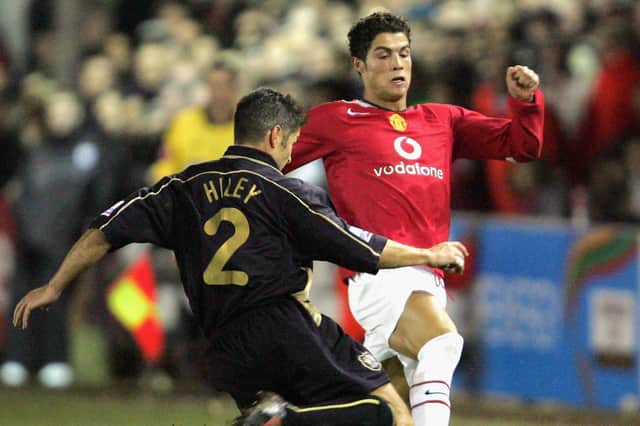
He later turned out for Crawley, Tiverton and then Cullompton Rangers, before hanging up his boots in 2008 at the age of 40.
During retirement, Hiley ran a B&B in Clyst St Mary, Devon, before moving to Manchester six years ago, where he is currently a manager with online grocery business Ocado.
He said: ‘It’s not the most sociable job because it’s shift work, but I don’t mind it. They’re a good bunch of lads and it’s physical as well, which keeps me reasonably fit.
‘Not that I tell anybody I’m a footballer. I don’t feel comfortable talking about myself and what I’ve achieved. Although, if people do realise who I am and want to ask questions, I’ll speak for as long as they want.
‘One person once recognised my name at work because he’s a bit older - now I’m getting good-natured stick all over the place! I have been in three or four jobs and it has taken years for people to actually realise what I’ve done in the past, I don’t talk about it.
‘I don’t need football in my life, I don’t crave for it now. It was once the love of my life, but things change, I no longer want to dwell on it, I don’t even watch football.
‘I loved early Man City, but now it’s boring. It’s pass, pass, pass, pass. I get it, you’re trying to find an opening, but it’s awful to watch. I get bored very quickly with football today.
‘I loved playing, though, really loved playing. I was so, so lucky to make a career out of it, I could never take that for granted, but I didn’t necessarily like watching it. Team-mates would study who they were up against the following weekend, but I didn’t.
‘I didn’t worry about who I was marking, I found out on the day. Is he quick or is he left footed? That’s all I needed to know, I didn't need to know the ins and outs of everything. It was football I loved, not watching it.’
Although, by his own admission, Hiley rarely talks about football these days, he still fondly recalls an impressive Fratton Park career transformation - and one of the great Pompey comebacks.
He once rued his Blues move, yet The Rock came to cherish it.
He said: I went from being spat at to having a poem written about me and a website created which became a bit of a cult thing.
‘It was one of the proudest moments of my career to be able to turn around such a passionate fanbase to the point where they actually embraced me, an ex-Southampton player.’