
'Seemed incredibly unlikely' - Portsmouth secretary reveals complexities in race against clock efforts to sign defender ahead of transfer dedline
Ever wondered how a transfer deal gets completed? Well, thanks to Pompey secretary Alistair Knell, we have a better understanding of the often difficult process.
Pompey club secretary Alistair Knell has provided a fascinating insight into the work that went on behind the scenes to ensure the Blues’ January transfer window pursuit of FK Haugesund defender Madiodio Dia was a success.
A deal to bring the Senegalese centre-back to Fratton Park on a two-and-a-half year deal was announced after the winter trading block officially closed at 7pm on Monday, February 2.
That was a familiar tale on the final day of the transfer window, with confirmations of the arrivals of Jacob Brown and Gustavo Caballero - plus Callum Lang’s exit to Preston North End - also left until after the deadline had passed.
What stood out, though, about Dia’s signing announcement was the fact there was no customary image of him in a Pompey shirt as he put pen (big or small) to paper on his newly-agreed contract.
It was clear from that moment that the 22-year-old had not travelled to the south coast or England for that matter to complete his Blues switch. And while The News’ Neil Allen last week provided a telling insight into how that particular move unfolded in the final hours of the transfer window, Knell has provided even more background on the complexities that arose and hurdles that needed to be overcome in order to get that ‘eyebrow-raising’ move over the line and to bolster a key area of John Mousinho’s squad.
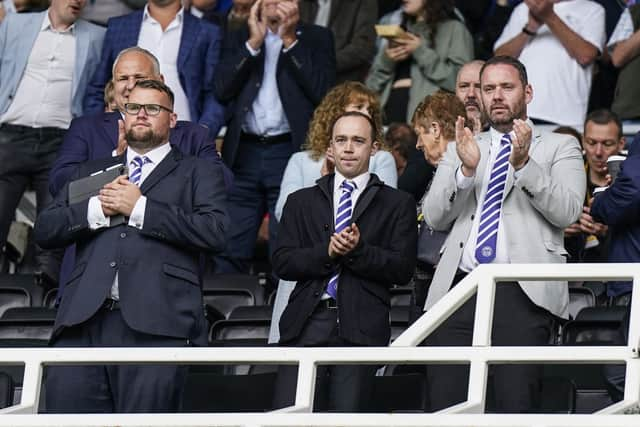

Working against the clock
Writing on Linkedin.com, Knell said he had effectively 24 hours to wrap up a deal for Dia, who was in Norway at the time, following conversations with chief executive Andy Cullen, sporting director Rich Hughes, John Mousinho and head of recruitment Brad Wall on Sunday, February 1.
That put him immediately under pressure, especially with the player not legally allowed to come to England at that particular moment for a medical. Yet solutions were found to set the wheels in motion.
Knell wrote: ‘I was approached by our CEO, Head Coach, Sporting Director, and Head of Recruitment at the club’s Training Ground, asking about the likelihood of bringing the deal to a conclusion ahead of the deadline, which was now only 24 hours away.
‘There was an element of nervousness, but a deeper level of excitement and pressure in undertaking an intricate transfer against the clock.
‘Our Sporting Director asked me whether it would be possible, given the circumstances, but this was only the case if the medical could take place abroad. Due to the player being Senegalese, he could not travel to the UK without gaining a visa prior to the journey, and there was not enough time remaining to gain a visa and complete the medical in time before the deadline.
‘The decision was made late on Sunday to fly the player to Oslo, as the club technical staff and the player's agents managed to call on contacts in the game to get the medical completed in the capital, and, to our benefit, the player would be able to complete a super priority visa appointment there.
‘The medical began on Monday and went on into the afternoon. The transfer agreement was finalised in the early afternoon and was drafted and finalised within an hour with the selling club, making this the quickest turnaround I have ever been involved in (the key is in the drafting).’
Dia’s registration submitted with 17 minutes to spare
According to Knell, though, plenty of work still needed to be done as he also attempted to apply the finishing touches to the other bits of business the Blues were conducting on deadline day.
He continued: ‘The player’s personal terms then needed to be agreed upon; these were sent to me at 14:54, and within an hour and a half, I had drafted the 11 registration documents required for international transfer.
‘These were then sent to the CEO and Sporting Director for internal approval before being sent over to the agent to ensure everything matched up. This is an important step, especially when you are working on and handling multiple deals simultaneously. It is vital you’re able to rely on those around you to double-check that what you are doing is correct, as there is no margin for error.
‘The player’s registration was submitted with a whole 17 minutes to spare, which, 24 hours before, seemed incredibly unlikely.
‘The feeling of pressing submit is a combined sense of relief and pride, immediately followed by fear and panic about ensuring you have submitted everything correctly and triple-checking the documents, despite them already being checked before submission. If there is ever a day when this doesn’t happen, I will be worried.’
Government’s new e-visa system failed to recognise visa
Knell admitted there was still an element of risk involved in their efforts to bring Dia to the club without knowing wheher he would secure a visa. Yet the gamble paid off, with the giant defender eventually linking up with Mousinho’s squad on Thursday, February 5, following a minor setback.
‘This transfer had a high level of risk involved, as we were essentially signing a player without a visa, which could potentially make him ineligible to work in the UK, resulting in the club having a player unable to play football despite being under contract.
‘Under FIFA RSTP (Regulations on the Status and Transfer of Players), a contract cannot be subject to a visa, so the club rely on me to provide accurate information on the legitimacy of players being able to transfer and obtain visas.
‘Tuesday saw Madiodio complete his visa appointment in Oslo, which, as it was completed on a super-priority booking, meant he got the decision by lunchtime Wednesday. The guideline turnaround time is usually 3 weeks when applied for outside of the UK, but this is reduced to 5 working days with the priority service, and then 1 working day with the super priority service. This was utilised to ensure that the Head Coach has the player in training as quickly as possible to come in and affect games.
‘On Tuesday evening, flights were booked for the player and his agents in the anticipation of us receiving good news on the player’s international sports person visa.
‘Once the visa was obtained, the player and their agents headed for Oslo Airport to travel to us in the UK. However, we encountered an issue when the UK Government’s new e-visa system failed to recognise the visa and update the online system, which led to the player missing his booked flight.
‘A later flight was then booked whilst our legal firm looked to seek answers from the Home Office and rectify the server error. All was thankfully resolved by late Wednesday afternoon, and the player touched down in London by 10 pm.’
Soul-searching was needed
Despite the stress involved in such a transfer, Knell said it remains a privilege to be involved in such important work for the club.
‘The January transfer window is by far the cruellest point of the season, coupled with a South Coast Derby and an FA Cup Third Round tie at home to Arsenalm’ he added.
‘Safe to say at times it required a fair bit of soul searching, as it is a struggle when the tasks are mounting on top of one another - but I see all of this as a privilege, thousands of people would love to do my job,
‘I’ve learnt a lot in this window, and with that, I hope it brings progress for the next.’