
"Proud moment for British" aviation as Royal Navy's first fully autonomous helicopter completes maiden flight

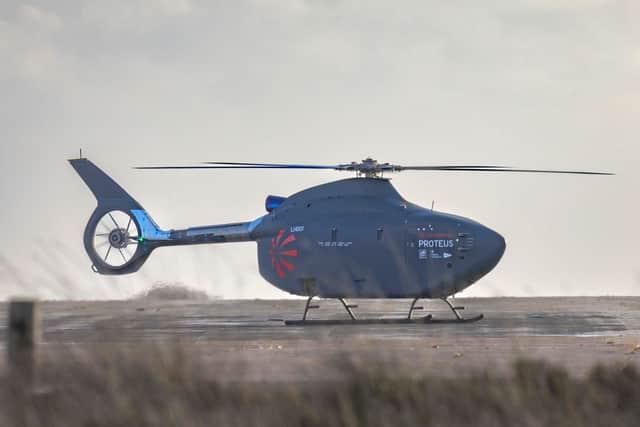
British aviation history has been made with the UK’s first truly autonomous full-size Royal Navy helicopter which has completed its first flight.
The helicopter, Proteus, which was built as a demonstrator for the Royal Navy, completed its first flight at Predannack airfield in Cornwall, marking a major milestone.
Manufactured in Yeovil, Proteus is being developed by Leonardo under a £60m programme to unlock the potential of uncrewed aerial systems, operating them side-by-side with crewed aircraft in a future ‘hybrid air wing’.

Luke Pollard, Minister for Defence readiness and industry, said: “This maiden flight is a proud moment for British innovation. Designed and built in Yeovil, Proteus supports skilled UK jobs while helping deliver the hybrid navy outlined in our Strategic Defence Review. Autonomous systems like this will be vital in protecting our seas without putting personnel in harm’s way”.
Just weeks after completing comprehensive ‘ground running’ trials at Leonardo’s Yeovil site engineers, technicians and representatives from Leonardo, the Royal Navy and UK Defence Innovation watched history in the making on the Lizard Peninsula.
Predannack serves as the satellite airfield for helicopters based at nearby RNAS Culdrose, near Helston, but is also key to developing uncrewed/autonomous systems as the National Drone Hub.
Commodore Steve Bolton, Royal Navy deputy director aviation future programmes said: “The successful first flight of Proteus is a significant step in delivering the Royal Navy’s maritime aviation transformation vision, and to demonstrating our steadfast commitment to investing in autonomy as part of a hybrid air wing.
“This milestone signals our intent to lead technological innovation, to enhance the fighting effectiveness of the Royal Navy in an increasingly complex operating environment, and to maintain operational advantage against evolving maritime threats.”
The successful flight delivers on key commitments in the Strategic Defence Review, which set out plans to create a ‘New Hybrid Navy’ with autonomous helicopters like this demonstrator playing a central role in hybrid air wings and the Atlantic Bastion programme to secure the North Atlantic.
In place of the crew in the cockpit/cabin, sensors and computer systems driven by cutting-edge software which enables Proteus to understand and process its environment, make decisions, and act accordingly.
With a greater than one-tonne payload, Proteus can carry a range of equipment to conduct tasks in challenging weather conditions such as high sea and wind states – and also frees up crewed aircraft to conduct other critical sorties.
During its first flight, Proteus was tasked with a short test routine which saw the aircraft operate its own flying controls independently of any human operator, all while under constant supervision and monitoring by test pilots on the ground to ensure flight safety.
Nigel Colman, managing director Helicopters UK, Leonardo added: “Proteus represents a step-change in how maritime aviation can deliver persistence, adaptability and reach – conducting the dull, dirty and dangerous missions in challenging environments without putting human operators at risk.
“As the UK’s only end-to-end rotary wing manufacturer it has been a pleasure working with the Royal Navy and seeing Proteus take off for the first time after being designed, developed, and manufactured at Leonardo’s Yeovil site is a fantastic milestone.”