
'Horrific' Royal Fleet Auxiliary maternity policies encouraging sailors to leave with some 'having abortions'

Constricting maternity policies are forcing women to leave the Royal Fleet Auxiliary (RFA) if they want to have a family - with some deciding to have abortions to keep their careers.
Female sailors feel as though they are being discriminated against and that mums are frowned upon within the naval support force. Women are asked to return to sea after having a child despite their partner being deployed in the RFA, or on operations in a similar force such as the Royal Navy.
Staff who spoke to The News said they’re given three options: take special unpaid leave and forfeit their salary, go back to maritime assignments and be separated from seeing their partner and children, or quit entirely. This sets up the startling choice between family life and career prospects.


“I was told it was my fault”
One experienced RFA sailor, who asked to remain anonymous, said the policies and treatment of women was “horrific”. She told The News: “It’s 2026. It’s an inappropriate set of options.
“I was advised to hire a nanny for a 24/7 period and hand over parental responsibility to my child. One woman was told to consider temporary foster care for her children, and try to get them back after her sea period.
“During my career interview, I was told it was my fault. I was told ‘mothers are a nuisance and it’s better for the organisation if we have none’, and ‘we should be grateful as having children is a lifestyle choice’.”
The sailor said some took drastic actions in order to keep their careers, and staff feel victimised. “I know women have had abortions because of this policy, which is wholly inappropriate,” she added. “In the past two years, I’ve had more of my friends sobbing and crying down the phone to me than at any time in my life.”
Martyn Gray, director of organising at the Nautilus International union, said he has heard “first-hand and second-hand accounts” of RFA sailors deciding to have abortions. He added: “They found out they were pregnant and felt that to continue in their careers, when weighing up the options, some took the decision to have an abortion. They felt there was simply not enough support to have family life."

The News has spoken to current and former sailors with knowledge of the situation, who all said women have decided to have abortions due to the policies in place. This was not presented as an option by management staff, with individuals making those decisions on their own. A Royal Navy spokesperson said: “The Royal Fleet Auxiliary offers a comprehensive range of support for parental, maternity, paternity, adoption, carers, and shared parental responsibilities.
“These provisions include enhanced leave entitlements and assistance tailored to their circumstances. We want every seafarer to feel they can build a fulfilling career with the RFA while being fully supported.”
“I did not feel supported” - How did we get here?
RFA sailors are civilians who provide provisions support for the Royal Navy, and can be deployed to conflict zones across the world. They conduct vital repairs and keep warships supplemented with fuel, food, water, spare parts, and other supplies. RFA Tidespring and Tideforce were part of the UK Carrier Strike Group’s Indo-Pacific deployment in 2025, headed up by HMS Prince of Wales.
Unlike Royal Navy personnel, there are no legal protections for dual-serving parents. Nor are there dual-serving protections if one parent is in the RFA, and the other in the navy. A new maternity policy was introduced in 2022 which would allow the primary care giver to be on shore assignments for up to two years, or until their child was three years old. This was later rescinded.
The RFA seafarer, who has been involved in disaster relief operations and recovered an exploded aircraft, said women weren’t told that the policy was reversed. After becoming pregnant in 2022 while land-based, she got an additional shore assignment in March 2023. Her partner serves in the Royal Navy. By March 2025, both would be asked to go back to sea in their respective forces.
“I asked for an extension on my shore post for three months,” she added. “I was told that would be discriminatory to men, despite knowing men who have done full term back-to-back shore posts. There was scope, but they didn’t want to. At no point did I feel supported. I felt like they were trying to push me out. I asked what support was there, and they gave me the resignation and unpaid leave paperwork, without me asking for it.
“They’ve done this to several women. They do not want women in this organisation. The women who I’ve spoken to all want to go back to sea. They’re not shirking responsibility, it’s just I personally don’t think it’s appropriate that to go back to sea, I put my child in temporary foster care or hire a nanny. Enhanced leave options do not exist.
“The only one is that you leave. If they want to get rid of you, they will request an occupational health referral for non-chronic conditions. If you’re pregnant, they will use occupational health as a reason to say you can’t go back to sea, or do your job.”
The experienced seafarer said the number of qualified RFA personnel has significantly dropped, with only 21 female qualified deck officers and eight qualified female engineers. Despite a small uptick, the force has been slowly losing staff over the past several years. According to Ministry of Defence Civilian Personnel Data, this has fallen from 1,921 in January 2018 to 1,664 in October 2025. Voluntary outflow has halved since 2023.
“You have a lot of experience departing for little reason,” she added. “The numbers fall when people think about having a family. There is no impetus to turn this around. They will blame everyone but themselves. Having children is not an unusual thing that people just don’t do. The organisation is showing people that they will simply not help them. What does that say if people come to them and say ’I need help’? The answer is nothing. They will throw people on sick leave at inappropriate levels. What on earth is that culture showing?
“Retention is the problem. People get so fed up as they’re treated badly. There is no reform. When they’re using language like ‘women are a nuisance’, and ‘you’ve made this lifestyle choice’, that’s very difficult to come back on. They just believe mothers and parents are difficult, and if they can just get rid of them, that’s fine. They refuse to do exit surveys, so they’re not capturing any information as to why people are leaving.”
The Royal Navy said RFA sailors are given exit surveys, and statutory maternity rights and flexibilities remain fully in place. The maternity policy was brought in line with current legislation.
“We were told ‘we’re not serving’”
Frictions have been affecting the RFA for several years. Staff went on strike in Portsmouth in 2024, campaigning for better pay and working conditions. Mr Gray previously said staff were “harassed” into returning to work early to fill gaps on deployments.
A pay rise was agreed at the beginning of 2025, with major reforms promised. Despite this, members of Nautilus International and the National Union of Rail, Maritime and Transport Workers (RMT) union are being balloted for industrial action. A 4.5 per cent pay increase, described as “wholly inadequate”, was rejected last month. Many seafarers believe the promised reforms never materialised.
Another female sailor, who has served for 18 years and is part of a dual-serving RFA family, spoke to The News about her experience. She fell pregnant in 2020, gave birth the following year, and returned to a shore post after maternity leave. Problems arose after this, with her husband maintaining his maritime career.
She said: “The RFA don’t recognise dual-serving parents, because we’ve been told ‘we are not serving’. This contradicts our full title of the Royal Fleet Auxiliary service. It’s been one big circle. After that shore post, my husband and I didn’t think we could both be employed. There was nothing for us. One, or both of us, had to resign. We were asked to champion the RFA as both parents serving together, but they didn’t do anything for us. The promise of bringing something in has never happened.”
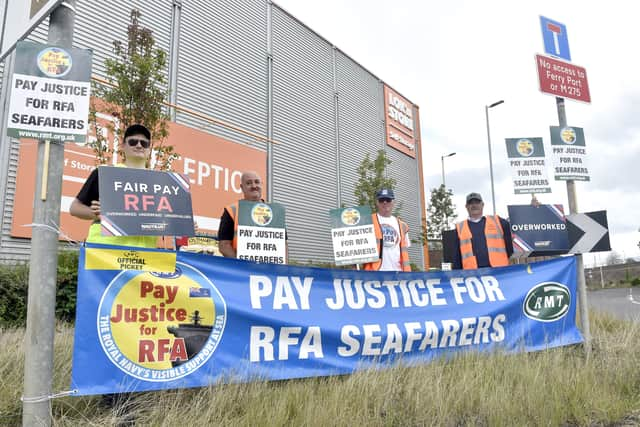
The experienced sailor said they were offered back-to-back appointments, where one would go to sea then the other immediately afterwards. Only one parent would be at home at a time. “We’d high-five at the gangway,” she added. “I was offered reduced hours on board a ship, but that isn’t flexible working, as I’m away for four months at a time.
“When you highlight the flaws of how this can’t work, you get radio silence. They keep sending lengthy emails that provide nothing. There’s so many holes or flaws, and they just ignore you. The RFA just says everything is fine. We’re not sick, we’re parents who want to work, and they’re not allowing us to work or give us the opportunity to do so. You’re never a family if you go back-to-back. It’s only perfect if you’re divorced.
“All my loyalty has gone and I doubt I want to continue to work for them. There’s nothing to support women or parents, especially if you’re in a relationship with another seafarer. A lot of people accepted it and walked away, but why should I sacrifice the career I’ve done all my life? Women should not have to choose between a career and a family.
“It’s not the RFA in uniform, it’s the civil servants running the organisation. That’s where we’re failing. If anything, we’re going on strike again. All the promises from the previous offer we agreed to have not been kept. It’s false promises.”
”Heart-breaking”
The strike ballot closes on February 17. Mr Gray said the union was “deeply concerned” by reports of discrimination against working mothers. “The maritime sector already struggles to retain talented professionals, and pushing out experienced mothers is not only morally wrong but operationally short-sighted,” he added.
“These women have dedicated themselves to supporting the Royal Navy’s vital operations, and they deserve workplace cultures that support rather than punish them for having children. Nautilus International stands firmly with any RFA personnel who have experienced this treatment.
“We are calling on RFA management to conduct a thorough investigation into these allegations and to implement robust protections for working parents. We urge any members who have experienced discrimination to come forward so we can support them and push for the systemic changes needed to ensure this never happens again.”
The issue of maternity was raised in parliament in December 2025. Minister for veterans and people, Louise Sandher-Jones, said: “The maternity and parental support package does include enhanced leave entitlement and tailored assistance through mechanisms such as occupational health. While consecutive shore postings have never been a defence policy, the RFA does support employees to use flexibilities in that offer.”
The force is being plagued by various problems, including various ships being in a state of disrepair - all contributing to declining staff levels. “Whenever we ask for change, all we get is ‘you’re a problem, you’re a nuisance’,” the first sailor said. “I want the RFA to survive. It’s a fantastic organisation. When I started, there were 18 ships in the RFA. Now they’re struggling to man five, it’s really depressing and heart-breaking.”
If you have experienced similar problems within the RFA and wish to share your story, you can contact us by calling Freddie Webb on 07801 195443, or by emailing [email protected]