
Fresh questions raised over long-running Tipner West redevelopment
A planning inspector challenged the council over housing density, heritage protections and views at Tipner West.
Portsmouth’s long-running and controversial plans for Tipner West face another hurdle, as a planning inspector questions aspects of the council’s project.
Tipner West, a parcel of land west of the M275, has been earmarked for major redevelopment for several years, with plans repeatedly scaled back.
In 2013, Portsmouth received £48.75m through the government’s Southampton and Portsmouth City Deal to explore opportunities for new homes and employment space.
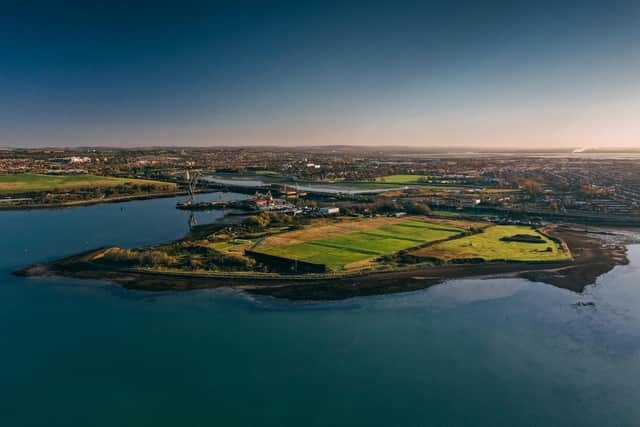

Plans for a 3,500-home development later evolved into the controversial Lennox Point super-peninsula, named in March 2021.
The ambitious project included land reclamation and a marine employment hub but faced strong opposition over its potential impact on internationally protected wildlife habitats.
In December 2021, councillors voted to pause the super-peninsula proposals and consider alternatives.
Revised proposals agreed in 2023 included at least 1,250 homes and 58,000sqm of employment space.
However, the government issued negative opinions in February and July 2025 on whether the development could be justified given its potential impact on protected habitats. Both opinions were subsequently withdrawn because of legal errors.
A revised Local Plan Addendum reduced the scale to approximately 1,000 homes and 25,000sqm of employment space.
The Portsmouth Local Plan, including the revised Tipner West allocation, was submitted for independent examination on March 18, 2026.
The planning inspectorate has now begun its examination to assess the “overall soundness” of the local plan and whether it satisfies statutory requirements.
Density
During the examination, inspector Mark Philpott said the council’s residential density figures were “incorrect”, stating that his calculations suggested the figure should be 114 homes per hectare, rather than 102.
Council officers acknowledged that there appeared to be “an error somewhere in what we’ve provided to you”.
Mr Philpott suggested the calculation could have been based on the residential-led approach for the site, known as option one, which proposes between 937 and 1,171 homes alongside 18,386sqm of employment space.
According to the council’s topic paper on Tipner West, option one delivers “the lowest relative financial deficit of each of the options”.
Masterplan
He also asked why an overarching conceptual masterplan was needed for the project.
Officers said this was “because it is such a sensitive site, along with Tipner East it will form a new gateway to the city”.
They added that the constraints, including heritage and environmental considerations, would create “an awful lot to take into account and we will want a holistic masterplan for the whole site”.
Views
One of the council’s emerging policies states that any development should “allow views to and from Tipner West” of notable landmarks such as Portchester Castle, Spinnaker Tower and the Historic Dockyard.
The inspector suggested that views should be considered rather than allowed, arguing that the use of allow “sounds like to me that a line of sight can’t be foreshortened”.
In response, officers said the policy was underpinned by the “same principle behind protecting the views from St Pauls Cathedral in London”, arguing that “consider” was not the right word.
Mr Philpott then asked: “what evidence do you have that these are critical views that should be maintained”.
Officers said the policy was about “placemaking” and that “there’s nothing unsound” about the planning authority arguing that something was important.
Heritage assets
Tipner West has several listed buildings on the site, including two former powder magazines, the shifting house and the boundary wall.
The council’s emerging policy states that heritage assets “must” be retained on site, which the inspector considered “unequivocal” and suggested replacing with “should”.
A conservation officer said he “advocated” for the policy because he wanted it to have “true robustness and a strength” and “absolute clarity”.
He clarified that there was nothing in legislation or policy to prevent Portsmouth City Council from concluding that assets on the site must be retained.
The examination will continue with further public hearings. Inspectors will then decide whether the Local Plan can be approved or needs changes before it is adopted. The process is expected to take around a year. The first hearing took place on October 6, 2026.