
Why Portsmouth cannot find cause of Millwall power cut - and why they believe it won't happen again

Andy Cullen admits Pompey and Scottish and Southern Electricity Networks have been unable to identify the cause of the Millwall power shortage.
But they are confident the subsequent implementation of fresh measures have ‘mitigated’ the chances of a Fratton Park repeat.
Following an investigation into last month’s cancellation, the Blues have installed a temporary generator, while SSEN have sanctioned an increase in power into the Fratton End and the presence of two members of their staff on match-days.
Since then, home matches against Bristol City and Norwich have passed without incident. The next Fratton Park fixture takes place tonight, with the Academy hosting Leeds in the FA Youth Cup (7pm).
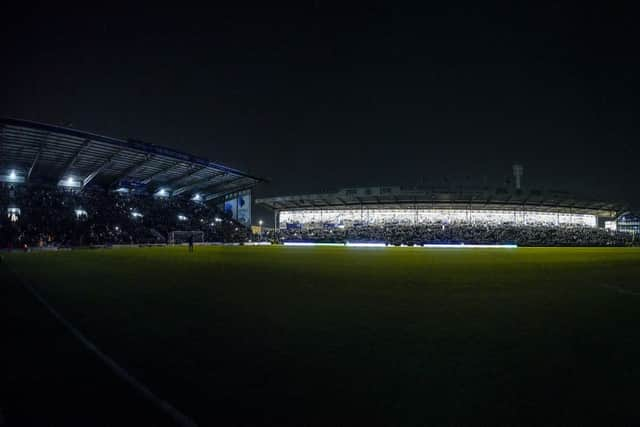

Attempts to pinpoint the source of the problem are ongoing, yet, in the meantime, Cullen believes Pompey and SSEN have reduced the likelihood of it occurring again.
The Blues chief executive told The News: ‘Previously, we had two power sources coming into the stadium. A substation in the north-east section of the stadium - which is enclosed and high voltage - and also one towards the Tesco area.
‘The Tesco one serves the North Stand and the Fan Zone, while the main one serves a number of neighbouring properties, including Fratton Park. It serves Fratton Park in terms of the floodlights, runs through the Milton End into the South Stand, then into the Fratton End.
‘There was a surge in the power involving the substation that evening, but what we still don't know is what actually caused that particular surge. Although it wasn't the Fan Zone or anything in the North Stand.
‘After a thorough investigation, working very closely with SSEN, while we could not identify exactly what the cause was, what we do know is the power on that night didn’t exceed anything that we’d had for the previous 12 months. There must have been a surge or spike which tripped the circuit breaker, which tripped the power.
‘So how do you mitigate the risk of it happening again when you don’t actually know what has caused the surge? Well, we’ve put some extra resilience into the system.
‘We have brought in an extra generator which independently powers the Fratton End and, by doing so, puts more resilience back into the other substation. At the moment it’s a temporary generator, but we might look at what we do long-term.
‘SSEN have also increased the loading into Fratton Park in that particular area, while they have kindly allowed two of their engineers to be with us on match-days for the time being until we can get that sorted.
‘They will be present for Coventry and also New Year’s Day (Swansea). If something did happen in that substation, they can get into it quickly and rectify it.
‘Having measured the resilience, we are now in a better place than where we were before. When you still have a degree of uncertainty as to what caused the surge that evening, it’s about mitigating it.
‘SSEN don’t believe it was something in the wider network drawing the power off - but they don’t know the cause either.
‘However, if it was to happen again we probably now have enough resilience. Until we know exactly what it is, we will continue with those measures.’

Meanwhile, November’s cancellation cost Pompey a ‘significant amount of money’, according to Cullen, with the club currently attempting to clarify details on a potential insurance claim.
He added: ‘It cost the club a significant amount of money.
‘Being a high-risk game, we had a massive police bill for the evening. We will obviously also need that for the rearrange fixture.
‘There’s a cost of all the staff that we’ll need to re-engage for the evening, stewarding, catering staff. We did take some catering income that evening, but not what we would normally expect. It was only pre-match sales - we didn’t get the benefit of half-time and post-match.
‘There’s obviously all the other areas in terms of hospitality which you must do again. There is a loss of anticipated income, some of which you recover in the rearranged game, but not necessarily all of it.
‘How much of that we might be able to get through insurance is something we’re working through at the moment.’