
Henry Nowak’s killer Vickrum Digwa has prison term increased at Court of Appeal

The time he has already spent in custody will count towards his sentence
Vickrum Digwa’s minimum term for the murder of Henry Nowak has been increased from 21 to 25 years after the Court of Appeal ruled his original sentence was “unduly lenient”.
The 23-year-old was jailed for life at Southampton Crown Court in June after stabbing the university student to death in the city on December 3.
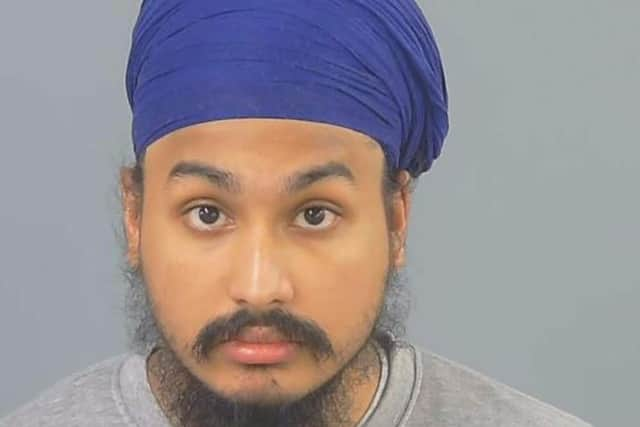

He filmed his victim as he lay dying and lied to emergency services where he told them the 18-year-old had racially abused him.
Attorney General Ellie Reeves referred the case to the Court of Appeal as “unduly lenient” earlier this year, while Digwa also sought to challenge the sentence as “manifestly excessive”.
In a ruling on Thursday, three senior judges said it was “unarguable” that the original sentence was too long, and found it should be increased to 25 years as it “fell outside the range reasonably open” to the sentencing judge.
Lady Chief Justice Baroness Carr, sitting with Mr Justice Nicklin and Mr Justice Wall, said: “A minimum term of 21 years did not adequately reflect the overall seriousness of the murder. It was not only lenient, but unduly so.”
Baroness Carr said Digwa filming the aftermath of the stabbing represented “incomprehensible cruelty” towards Mr Nowak, which caused him “additional distress and degradation”.

The judge also said the fact that Digwa, as a Sikh, was legally allowed to carry the knife “does not reduce the seriousness of its subsequent lethal use” against Mr Nowak, whom she described as “unarmed and otherwise defenceless”.
She continued that sentencing judge William Mousley KC “identified many of the relevant features” of the case, but his “overall assessment materially understated two distinct dimensions of the offending”.
She said: “First, the circumstances in which a large and immediately available dagger was used repeatedly with an intention to kill an unarmed man; and secondly, the deliberate cruelty, additional suffering and obstruction which followed the stabbing.”
The time Digwa has already spent in custody will count towards his longer sentence.
The killing sparked unrest when police body-worn video was released showing officers handcuffing Mr Nowak, from Chafford Hundred, Essex, as he was dying.
Jonathan Polnay KC, for the Attorney General, told the hearing on Thursday, November 5 that Digwa “repeatedly deployed” the knife against an “unarmed and defenceless stranger”, and the sentence “failed adequately to reflect” the aggravating features in the case.
These included that Digwa “abused the privilege” extended to Sikhs allowing them to carry blades in public and that he filmed Mr Nowak following the attack, during which he “zoomed in on Henry’s face whilst verbally gloating”.
Imran Khan KC, for Digwa, argued the sentence passed by Judge William Mousley KC already reflected the aggravating features of the case, including the filming, the use of the knife and the “abuse of religious privilege”.
He said the sentence should instead be reduced to a “materially lower minimum term”.
Mr Nowak’s family members attended the hearing at the Royal Courts of Justice, in London.
Digwa, appeared via a video link from HMP Frankland in County Durham and was wearing a dark suit, shirt and tie. He appeared to show no reaction as his sentence was increased.
At his sentencing hearing in June, Judge William Mousley KC said that on the night of the murder, Digwa had a small knife hidden from view called a kirpan, which is a strict requirement for Sikhs to have at all times and can be carried in public for religious reasons.
Digwa also had a “large dagger in a sheath”, due to being part of an order of Sikhs called the Nihang, who have a tradition of having a second knife.